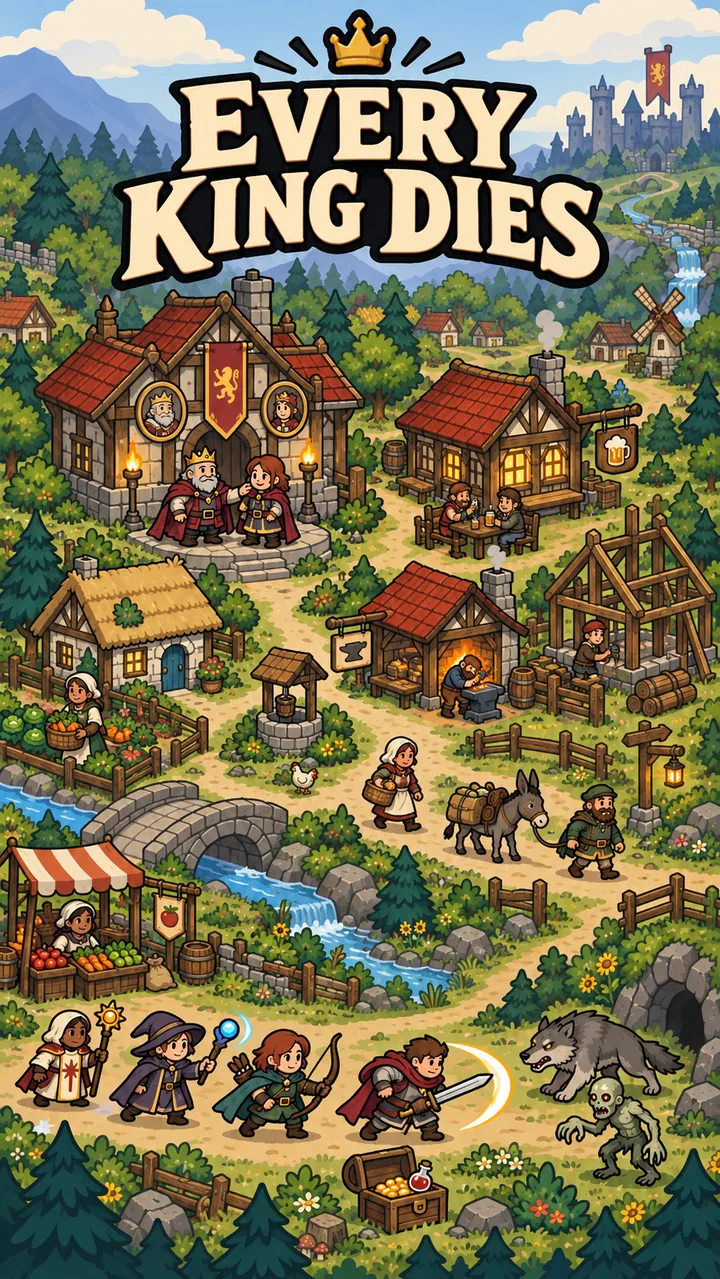
I chose unfamiliar technologies on purpose for Upwardly Math, but video game development is a different beast altogether. You build a back-end simulation engine, wire a visual world on top of it, then work through the exhaustive creative process of making 2D and 3D art.
With no artistic talent of my own, relying entirely on agentic image generation, I've had to learn how to describe and break down what I'm asking for so an agent can draw it. Talk to me about sprite sheets that produce semi-accurate walking animations. Talk to me about building art. No, I mean art of buildings: construction stages, and what it looks like inside when the front door opens. Graphic design may not be as hard as marketing (hello, marketing pros!), but it's a close second.
The most fun and reinforcing lesson: on Upwardly Math I don't have a teaching license or a teaching career to guide my judgment, but I do have a lifetime of knowing what makes games fun for me. Every King Dies showed me how far good ideas and vision can take you in this new world of software delivery. Good ideas, a vision broken into stepping stones toward a goal, and pragmatic trimming are a superpower now.
I've never built a video game before, but my software career taught me to recognize when I've beaten my head against a wall too long and it's time to pivot a feature or its content. It taught me to focus on design and planning, and that a strong spec and story behind a feature improve implementation and testing. Those lessons from my engineering career ring just as true in game development with agentic delivery.